|
EVANDALE MARKET
CLARENDON HOUSE
INFO EVANDALE
|
SPONSORS
accent on
 tasmania
|
follow updates on
| |
Launceston
EVANDALE
|
 |
Evandale
is another one of those historical rural towns like it's counterpart Richmond
near Hobart. Just about every building in the main street has been listed by the National trust.
Evandale is 20 km south of Launceston at the southern end of Launceston airport
runway. It is a classified historic town, with superb heritage buildings which
remain in largely original condition.
We
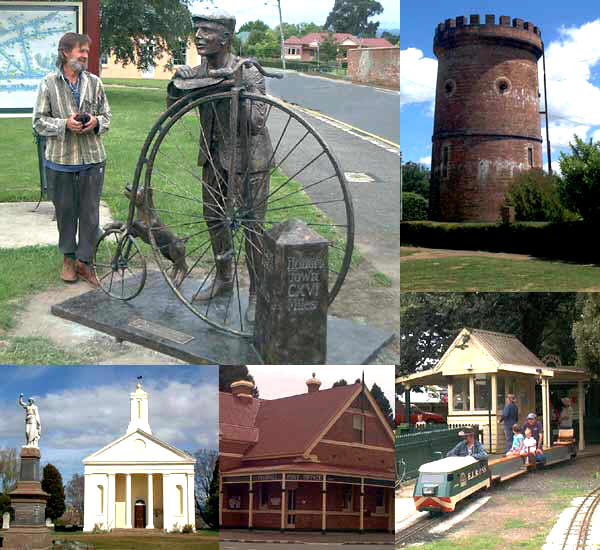
happened to turn up when Ron Gaston was putting the finishing touches to his
sculpture 'The Time Traveller'. Evandale hosts the Australian National
Penny Farthing Championships in February each year. A large market is
held in the town every Sunday until 1PM. The miniature train is adjacent
to the
market. |
 |
 |
| |
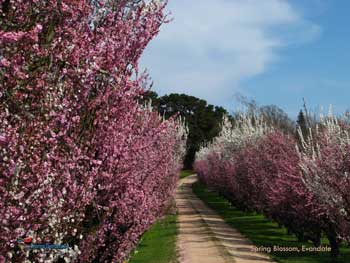
The picture above is Leighton Stud between
Launceston airport and Evandale. Right at the southern end of the runway.
At it's best the first 2 weeks in September.
|
Historic
Buildings in Evandale
With a
town like Evandale it is imperative to get a copy of Let's Talk About Evandale.
This informative brochure, which is free, lists no fewer than 38 buildings and
sites of historic in the town and over 70 in the district.
The
buildings of particular interest in Evandale include the former Presbyterian
Manse (1840), a typical colonial building opposite Barclay Street in the town's
High Street, 'Blenheim' (1832), a one-time hotel on the southern corner of
Barclay and High Street, which was originally known as the 'Patriot King William
IV', St Andrews Uniting Church (1840) in the High Street with its classical
belltower and Doric columns, and a number of buildings at the intersection of
Russell Street and High Street including the Clarendon Stores (1836), an early
saddler's shop (1840) and the Prince of Wales Hotel (1836).
This
barely scratches the surface of the rich diversity of the town. It is sensible
to give it about half a day and to wander around accompanied by a good detailed
local map. A shorter visit would definitely include a walk down Russell and High Streets
which are two of the most attractive historic main streets in Tasmania.
|
|
|